Mediterranean Quesadillas with Spinach, Feta, Mozzarella, and Red Onion
Introduction
Hello — I’m Carla Carter, Founder & Recipe Developer of RecipesCabin. If you’re looking for a simple, satisfying dinner (or an easy lunch or snack) that feels a little Mediterranean and comes together quickly, these Mediterranean Quesadillas with Spinach, Feta, Mozzarella, and Red Onion are for you. This recipe is for anyone who wants flavor without fuss: busy weeknights, cooks who are still gaining confidence, or anyone returning to the kitchen after a break.
What makes this approachable is that it uses familiar components — tortillas, a couple of cheeses, some fresh vegetables — and a short, predictable cooking process. You don’t need a lot of special equipment, and the steps are straightforward. I’ll walk you through each moment, explain why it matters, and give you the visual and tactile cues to know you’re on the right track. Small imperfections are part of home cooking, and they won’t ruin the result; they’ll just make it real.
Why this recipe is easy to get right
This recipe is very forgiving. The filling is a loose mix rather than a precise batter; it can be scooped, spread, or heaped without exact measurements. The cooking happens on a skillet where a few visual cues — a golden-brown surface, melted cheese peeking at the seam, a light crisp to the tortilla — let you know when it’s done. You won’t need a thermometer or special timing tools.
Where the recipe allows flexibility: you can chop the spinach fine or leave it in slightly larger pieces, slice the red onion paper-thin for mildness or a bit thicker if you like more crunch, and adjust the pepper to taste. None of these changes require new steps or exact science. Because the filling centers on cheese that melts, small differences in packing or heat won’t make the whole thing fail — the cheese binds everything together as it warms.
This is suitable for all skill levels because the main techniques are easy to master: mixing, folding, and pan-frying. Each one gives clear, visible feedback, so you’ll feel more confident as things start to look and smell like they should.
How to make Mediterranean Quesadillas with Spinach, Feta, Mozzarella, and Red Onion
Think of the process in three gentle stages: assemble, fill & fold, and cook.
First, you’ll mix the filling ingredients. This is where flavors meet and you get a sense of the texture. Aim for a balanced mix where the cheese, spinach, and tomato are evenly combined. The mixture should hold together a bit from the cheeses but still be easy to spread.
Next comes filling and folding. Spoon a portion onto half of a tortilla and fold it over. You’re aiming for a tidy semi-circle, not a perfectly sealed pocket. If the filling spreads to the edges, that’s okay — you’ll see how the tortilla crisps and keeps it contained during cooking.
Finally, cook the quesadilla in a lightly oiled non-stick skillet. Medium heat is your friend here: hot enough to crisp the tortilla in 3–4 minutes, but not so hot that the outside burns before the cheese melts. Flip and repeat on the other side. When both sides are golden and the cheeses are melted, you’re done.
Beginners should slow down when mixing the filling and when first placing the filled tortilla in the hot skillet. Mixing lets you check for seasoning and balance; the skillet step gives you the chance to control the heat so the outside browns evenly while the inside reaches a melty, warm texture.
Ingredients
4 flour tortillas, 1 cup fresh spinach (chopped), 1/2 cup shredded mozzarella cheese, 1/2 cup crumbled feta cheese, 1 small tomato (diced), 1/4 cup red onion (thinly sliced), 1 tablespoon olive oil, Black pepper (to taste)
Each ingredient plays a simple, important role:
- 4 flour tortillas: They are the structure — flexible and mild in flavor, they crisp up nicely and hold the filling together. No specialty flatbread is needed.
- 1 cup fresh spinach (chopped): Adds color, a gentle leafy texture, and a fresh flavor that brightens the richness of the cheeses. Chopping makes it easier to distribute evenly.
- 1/2 cup shredded mozzarella cheese: The melty glue. Mozzarella melts smoothly and creates the creamy, slightly stringy texture that gives a quesadilla its comforting mouthfeel.
- 1/2 cup crumbled feta cheese: Brings a salty, tangy contrast to the mellow mozzarella. Crumbled feta disperses easily so each bite gets a nibble of its flavor.
- 1 small tomato (diced): Freshness and a little juiciness. Dice it small so it warms through quickly without making the filling soggy.
- 1/4 cup red onion (thinly sliced): A sharp, crisp note that sweetens as it cooks. Thin slices mean a mild onion presence that complements rather than overpowers.
- 1 tablespoon olive oil: For the skillet — it helps the tortilla crisp and adds a subtle, fruity richness.
- Black pepper (to taste): Simple seasoning that lifts the whole mix. Use a couple of twists, taste, and adjust.
None of these are complicated or intimidating. They’re easy to find, easy to prep, and they work together by balancing meltiness (mozzarella), tang (feta), freshness (spinach and tomato), crunch/sharpness (red onion), and crispness (tortilla).
Directions
In a mixing bowl, combine the mozzarella cheese, feta cheese, spinach, tomato, red onion, and black pepper. Mix well., Lay one tortilla flat and place one-fourth of the filling mixture on half of the tortilla. Fold it over to cover the filling., Heat a non-stick skillet over medium heat and add olive oil., Place the filled tortilla in the skillet and cook for about 3-4 minutes until golden brown., Flip carefully and cook for another 3-4 minutes until both sides are crispy., Remove from heat, slice into wedges, and serve warm.
Supportive guidance for these exact steps:
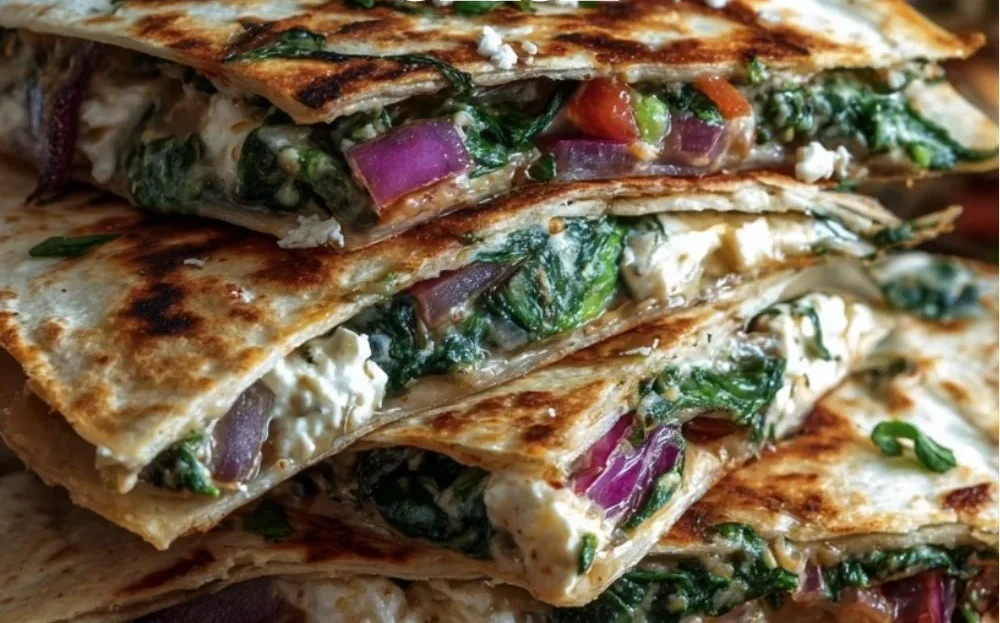
“In a mixing bowl…” — As you combine the cheeses and vegetables, look for an even speckling of white (feta and mozzarella) and green (spinach) with small bits of red tomato and purple-red onion. The mixture should be moist from the diced tomato but not soggy. If one ingredient seems thicker in one spot, stir a few more times; uniform distribution is the key to even flavor in each wedge.
“Lay one tortilla flat…” — When you spoon the filling, imagine a crescent of mixture sitting on one half, leaving a little margin at the curved edge so the filling doesn’t spill out during flipping. Fold it gently — you’re creating a neat half-moon. If a bit falls out, it’s okay; it can crisp in the pan and be tasty niblets.
“Heat a non-stick skillet…” — Medium heat is important. Look for a shimmer in the olive oil and a faint scent of warmth. If the oil begins to smoke, the skillet is too hot — lower the heat a touch. If you don’t use oil, the tortilla will crisp less evenly; a thin coat of oil encourages an even golden color.
“Place the filled tortilla…” — You’ll hear a quiet sizzle when it hits the pan. After 3–4 minutes the surface should look evenly browned and feel firm when you nudge it with a spatula. If the first half-minute shows excessive browning, reduce the heat and give it a minute longer at a gentler temperature.
“Flip carefully…” — Use a wide spatula to support the quesadilla so the filling stays inside. The second side often takes the same time. Both sides should be a uniform golden brown and the edges may blister slightly — a good sign the interior is warm and the cheeses have melted.
“Remove from heat…” — Let the quesadilla rest for a minute before slicing. This brief rest lets the cheeses settle so the wedges hold together when you cut them. Serve warm; the aroma is inviting and the inside will be creamy and comforting.
If things don’t look perfect at first — perhaps a tortilla browned unevenly or a bit of filling escaped — that’s normal. Adjust heat, press gently with the spatula, and remember that taste and texture matter more than cosmetic perfection.
Key techniques you’ll practice in this recipe
- Mixing to distribute flavors: You’ll practice combining wet and dry ingredients so every bite contains a balanced mix. This skill transfers to salads, fillings, and many comfort dishes.
- Folding and portioning: Learning how much filling to place on a tortilla and how to fold without overstuffing will help with wraps, stuffed breads, and turnovers.
- Pan-frying for color and texture: Controlling medium heat so the outside crisps while the inside warms and melts is a foundational stovetop skill. It’s useful for grilled sandwiches, quesadillas, and seared flatbreads.
- Judging doneness visually and by touch: You’ll learn to look for golden color, slight firmness, and melted cheese rather than relying on timers alone.
Each technique is gentle and builds confidence because they provide immediate, visible feedback.
Common mistakes and how to avoid them
- Overfilling the tortilla: If you pile on too much filling, the quesadilla can split or the filling may escape. Fix: Use roughly one-fourth of the filling per tortilla as directed, and leave a small rim at the edge when you fold.
- Skillet too hot or too cold: Too hot = burnt outside with unmelted inside. Too cold = long cooking time, oil absorption. Fix: Start at medium heat; lower the setting if the tortilla browns in under a minute.
- Soggy filling from large tomato pieces: Big tomato chunks can release more moisture. Fix: Dice the tomato small as instructed; if it’s extra juicy, gently pat with a paper towel before adding to the bowl.
- Not supporting the quesadilla when flipping: The filling can spill if the tortilla isn’t supported. Fix: Use a wide spatula and flip with confidence, supporting the entire half-moon.
- Rushing the resting time: Cutting too soon can cause the filling to run out. Fix: Let it sit a minute after cooking to set.
If something does go off track — say one side browns faster — simply reduce the heat and finish more slowly. If some filling spills and crisps on the pan, scrape it off and enjoy as a crispy bite or discard it — it won’t ruin the rest.
How to adjust confidently without changing the recipe
You may want to scale portions, tweak flavors, or change textures in future tries — conceptually, here’s how to think about adjustments while keeping this recipe intact:
- Portion scaling concepts: The recipe makes four quesadillas. To serve more or fewer people, scale all components proportionally. If you double the recipe, mix your filling in a larger bowl and cook in batches so the skillet isn’t overcrowded.
- Flavor preference adjustments: If you prefer more tang, increase the proportion of feta within the filling when you mix; if you like milder flavor, increase mozzarella slightly. Because mixing is the first step, taste and adjust before filling the tortillas.
- Texture tweaks (conceptual only): For a crispier tortilla, increase the heat slightly but watch the color closely. For a softer interior, reduce cooking time a bit and keep the filling chunkier. These are conceptual changes — you’re not changing the ingredients or steps, only how you execute them.
When making adjustments, do one change at a time so you can see its effect and learn what you like.
Serving, storage, and reheating made simple
Serving: Slice each quesadilla into wedges and serve warm. They’re wonderful with a simple green salad, a dollop of plain yogurt or tzatziki, or a squeeze of lemon for brightness. The contrast between warm, melty interior and crisp tortilla makes each wedge satisfying.
Storage: Cool any leftovers to room temperature, then store in an airtight container in the refrigerator for up to 3 days. The tortilla will soften a bit in the fridge, but the flavors hold up well.
Reheating: For best texture, reheat in a skillet over medium-low heat for a few minutes on each side until warm and crisp again. You can also use a toaster oven on a low setting. Microwaving will warm the filling but may soften the tortilla; if you microwave, pop the quesadilla into a hot skillet for 30–60 seconds afterwards to regain crispness.
Questions new cooks often ask about this recipe
- How do I know when the cheese is melted enough? Look for the tortilla to be golden and the edges to show slight bubbling or softness where the cheese is inside. A gentle press with a spatula should feel cohesive rather than runny.
- Can I use whole wheat or corn tortillas? The recipe calls for flour tortillas for their flexibility, but you can try whole wheat flour tortillas. Corn tortillas are drier and more likely to crack when folded, so be gentle if you use them.
- My tortilla browned too fast — what happened? The skillet was likely too hot. Reduce to medium and give the interior an extra minute to warm through.
- Is it normal for some filling to leak out? Yes. That happens sometimes and those bits crisp up and are usually tasty. Don’t worry — the main quesadilla will still be delicious.
- Do I need a non-stick pan? A non-stick skillet makes the process easiest and reduces sticking. If you use a well-seasoned cast iron, that works too; just watch the heat more closely.
Final encouragement from Carla
Cooking is a practice, not a test. With this recipe you get clear, visible signs at every stage: a well-mixed filling, a neat folded tortilla, a golden crust, and warm, melted cheese inside. Those are simple, reliable checkpoints that will build your confidence.
If something isn’t perfect the first time, remember that dinner still tastes great and you learned what to tweak next time. Keep going, try small adjustments deliberately, and celebrate that you made a satisfying meal with your own hands.
Happy cooking — and enjoy those wedges!
Carla Carter
Founder & Recipe Developer, RecipesCabin
Conclusion
If you’d like a different take or extra inspiration, try this Easy Mediterranean Quesadillas for a similar recipe with helpful photos. For budget-friendly variations and tips on stretching ingredients, see Mediterranean Quesadillas – Budget Bytes. If you want another flavor twist that includes olives and additional ideas, take a look at this Mediterranean Magic: Spinach, Feta & Olive Fiesta in a Quesadilla ….
Mediterranean Quesadillas
Ingredients
Method
- In a mixing bowl, combine the mozzarella cheese, feta cheese, spinach, diced tomato, red onion, and black pepper. Mix well.
- Lay one tortilla flat and place one-fourth of the filling mixture on half of the tortilla. Fold it over to cover the filling.
- Heat a non-stick skillet over medium heat and add olive oil.
- Place the filled tortilla in the skillet and cook for about 3-4 minutes until golden brown.
- Flip carefully and cook for another 3-4 minutes until both sides are crispy.
- Remove from heat, slice into wedges, and serve warm.